
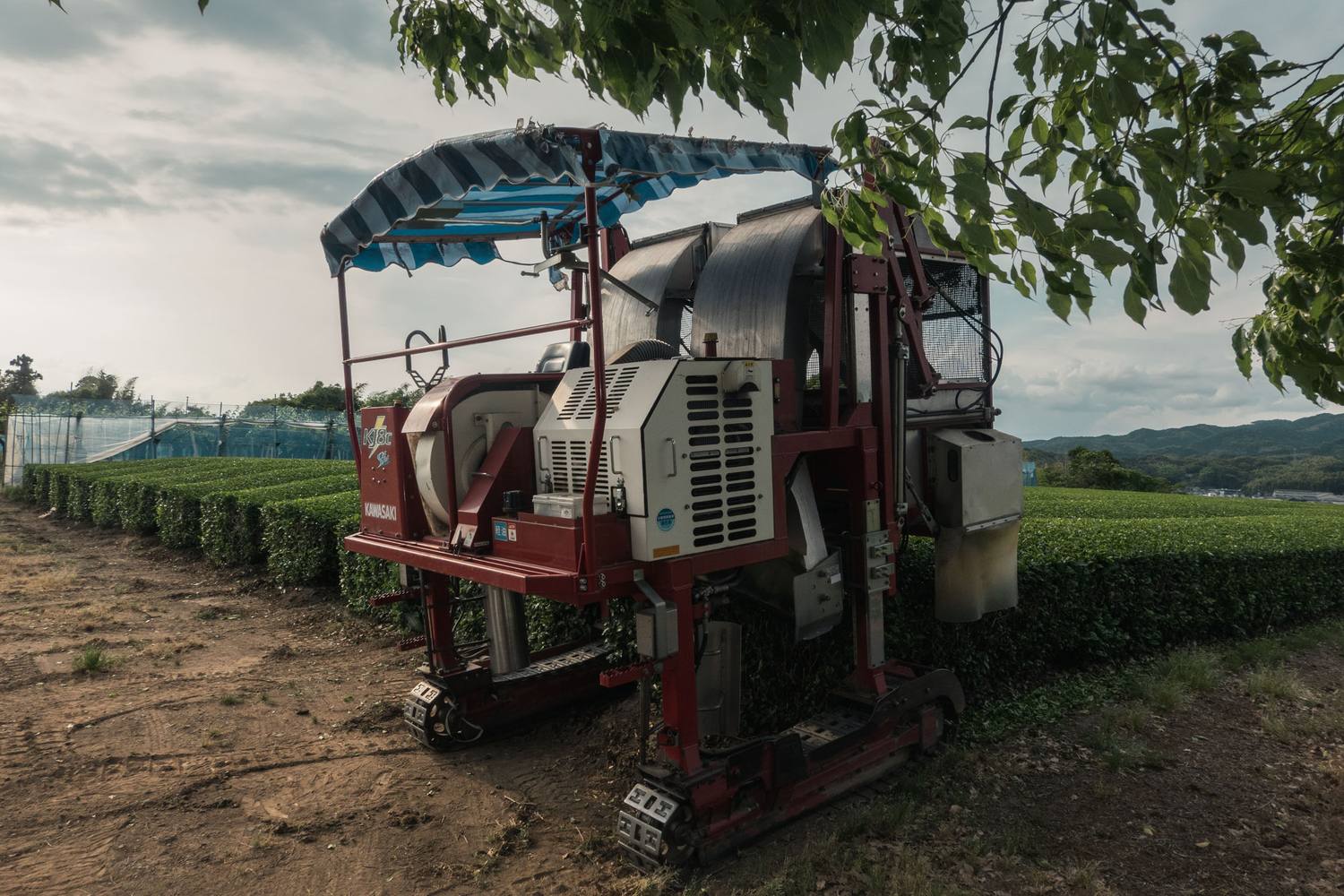
Between 2000 and 2024 the number of commercial tea-farming households in Japan fell from 53,687 to fewer than twelve thousand. In Shizuoka, the largest producing prefecture, the count fell 43.5% in five years, to 5,012 in 2025, according to the Kanto Regional Agricultural Administration Office. More than 70% of the growers still working are over 65. Fewer than fifteen hundred are under 49.
Set against that, the market looks extraordinary. Kagoshima's tencha trading session in July averaged ¥8,738 a kilogram, half again on the year, with a top lot at ¥15,911 — and the first flush had already gone up 1.8 times. Shizuoka's second flush closed at the highest prices on record, 70 to 80% above a year earlier and three and a half times 2024. Ito En, which holds more than 30% of Japan's green-tea drinks market, reported a fall of more than 70% in net profit for the year to April 2026 and said leaf costs had risen tenfold in a decade.
Both things are true at once, and that is the shape of Japanese tea in 2026: the highest prices anyone can remember, paid into an industry with fewer people in it every year. The boom is not reaching the farms evenly, and the part of the crop least likely to be rescued by it is the part matcha's reputation was built on.
What a boom rewards
Tencha is roughly 6% of Japanese tea production, and conversion to it is the trade's dominant story. Farmers who grew sencha are switching, which has hollowed out the everyday teas behind them: hojicha raw material has quadrupled in two years, and a Uji merchant has said publicly that 100 grams could reach ¥1,000 if the trend holds. Thirteen tea processors closed or dissolved last year, a record.
But conversion has a direction, and it is towards whatever scales. Machine harvest over hand. Synthetic shade cloth over reed screens and rice straw. Ceramic bead mills, which produce something like twenty kilograms of powder an hour, over granite ishi-usu, which produce somewhere between thirty and forty grams. That ratio runs to several hundred to one, and it is not a detail — it is the whole economics of the category in a single number.
More than 95% of Japanese tea is already machine-harvested. The remaining 5% is tezumi, picked by hand, and in the oldest fields honzu, shaded under reed screens and loose rice straw rather than black net. It is the most labour-intensive tea in Japan to make. On a farm short of hands and short of a successor, it is the first thing to go.
What disappears, and how
The losses do not arrive as statistics. In Shimizu, a tea merchant called Ogino Shoten that had made a locally famous matcha soft serve for thirty years announced it would close in June 2026 for want of anyone to take it on; before shutting, its staff taught the recipe and the method to a neighbouring sporting-goods shop. In Saga's Seburi mountains, Eisai tea — cultivated there since the twelfth century, and named for the monk who is supposed to have brought tea seed back from China — is down to a handful of producers, and a symposium in Tokyo this September has been convened to ask what happens next.
This is what the decline looks like at ground level: not a market collapsing, but a series of individual decisions not to continue, each of which removes a specific field, a specific cultivar and a specific way of doing it. Prices at the auction floor say nothing about whether the person who grew the lot has anyone to hand it to.
The buyer who kept showing up
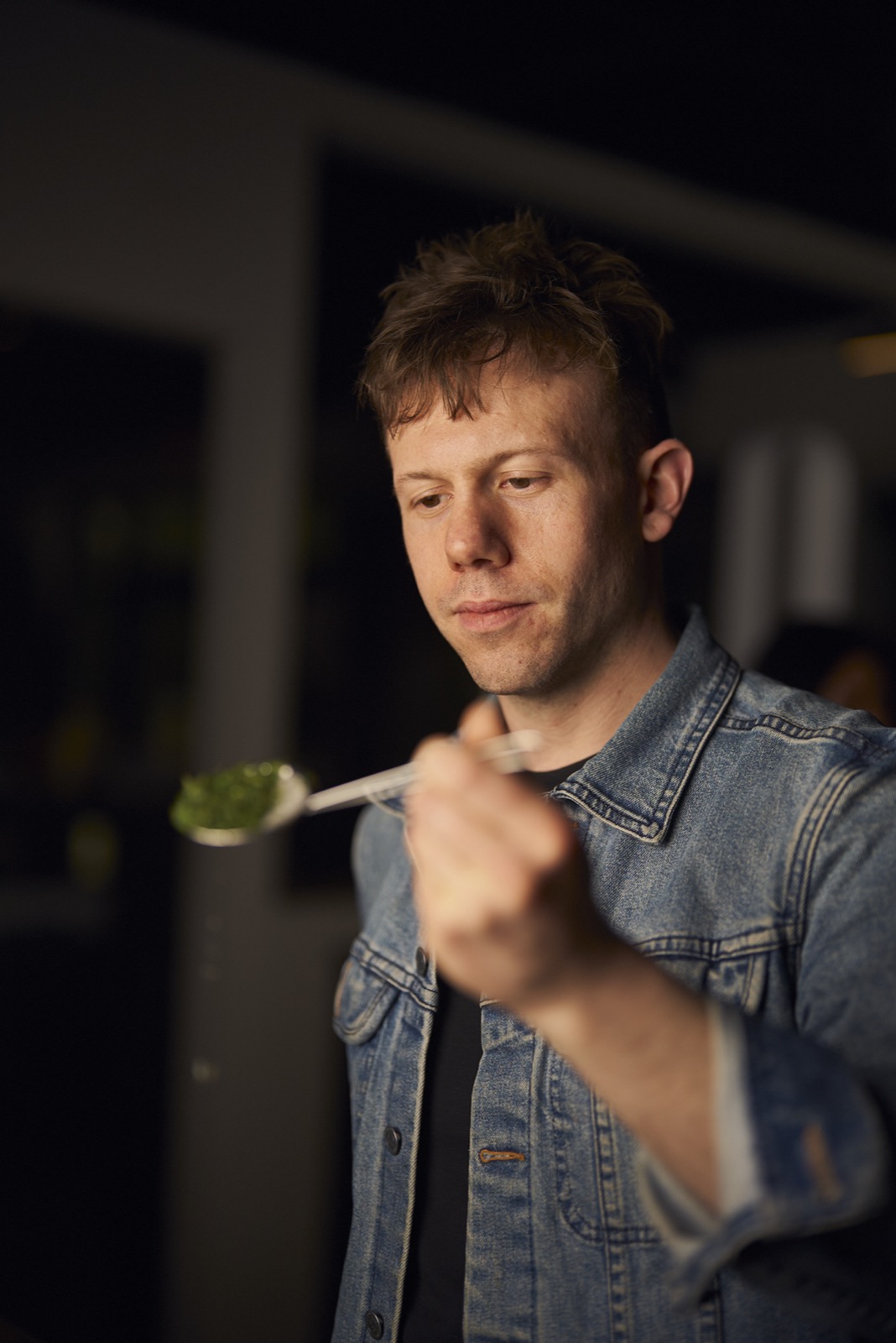
Ooika, founded in 2019, buys into that 5% deliberately, and Marc Falzon's route to it was not a commercial one. He trained in fine art and photography; the tea came during graduate school, on a trip to eastern China, in a market in Hangzhou where he spent three hours drinking with a seller. "It completely changed my idea of what tea was," he told Edible Jersey.
What followed reads as an apprenticeship rather than a business plan: study under Shunan Teng at Tea Drunk in New York from 2015, then Japan, and in 2017 matcha, in Uji. Ooika came two years after that, along with imported ishi-usu stone mills. In 2020 the borders closed, and the milling that was meant to stay in Japan happened in New Jersey instead — which is how a company sourcing from Kyoto ended up describing itself as the largest matcha refinery in the West.
The farms it buys from are named on the packaging, which is unusual enough that this publication has written about it separately. Tsujiさん in Shirakawa, Uji, holds Prime Minister's and Emperor's awards. Yamazakiさん in Gokasho has taken first place in the All Japan Tea Competition three times. Sakataさん in the Hamadai basin holds a Minister of Agriculture award for tencha; Shimizuさん in Kageyama is a ninth-generation Uji grower farming with his two sons. In Fukuoka, Kurazumiさん in Hoshino has taken first nationally three times, and Eshimaさん leads the 700-member Yame cooperative.
Falzon has been explicit that access of that kind is not bought:
It took years to earn trust. You can't just show up with money and expect to buy the best tea. There's a level of humility and consistency required. I just kept showing up, drinking tea, and listening.
It is a claim that is easy to make and hard to fake, because the growers it concerns are the most decorated in Japan and have no shortage of buyers. The competitive fact underneath it is duller and more useful: most heritage tencha growers do not own stone mills, so a Western brand buying "direct" is usually buying powder somebody else ground. Grinding it yourself is what makes naming the grower possible at all.
What the position costs
Refusing to blend means refusing the one thing wholesale buyers most want, which is a flavour that does not move. Single-cultivar, single-vintage matcha changes every season and then runs out; when this publication counted in August 2026, Ooika had seven teas in stock against roughly thirty listed as sold out. A café that builds a drink on one lot has to rebuild it when the lot ends.
The 24-hour rule — nothing served that was ground more than a day earlier — caps the business at the speed of granite. Twelve mills at a few dozen grams an hour each is the ceiling, and no amount of demand moves it. Printing the farmer's name on the bag hands every competitor a list of exactly whose gate to knock on. Ooika says it spends nothing on paid advertising and directs its entire marketing budget to nonprofit partnerships instead.
None of that is a marketing position. Every item on the list is a constraint the company has taken on by choice, and every one of them makes it smaller than it would otherwise be. That is what buying from the 5% looks like on a balance sheet.
Whether it can work
It is worth being exact about what a buyer can and cannot do here, because the word preservation is doing a great deal of work in this part of the trade and is rarely examined.
One company cannot preserve a farming system. By the arithmetic of stone milling, Ooika's volumes are small, and what actually decides whether the hand-picked 5% survives is succession, land consolidation, prefectural support and whether a 68-year-old in Uji has a child willing to take the fields. A foreign buyer paying above market for tezumi honzu tencha changes the economics for a handful of families. It does not change them for a prefecture.
What a buyer can do is narrower, and it is worth stating precisely: make the distinction legible. A field shaded 43 days under rice straw and picked by hand costs several times what a machine-cut, net-shaded field costs, and for most of the last century the finished product told the customer nothing about the difference. Where the label carries the method, the price has something to attach to. Where it does not, the cheapest way of making it wins by default, and the 5% becomes a story about heritage rather than a line of business.
That is the bet, and it is not yet settled. The auction figures at the top of this piece show a market willing to pay record money for tencha in general. Whether it will pay a further premium, reliably and in a bad year, for the slowest version of it is the question the next few harvests answer.
Disclosure
Matcha Wire is published by Ooika, and this article is about Ooika's founder. Nothing in it was said to Matcha Wire for this piece: every quotation is taken from published interviews, and every figure comes either from third-party reporting or from Ooika's own public pages, all listed below. Readers should weigh it accordingly. Corrections go to hello@ooika.co.
Sources
- Edible Jersey, "The Aroma of Shade: Matcha" — interview quotations and biographical detail
- Experience Princeton, "Business Spotlight on Ooika"
- Shizuoka Shimbun, "Shizuoka tea producers fall 43.5% in five years", 5 August 2026, citing the Kanto Regional Agricultural Administration Office, MAFF
- Minami-Nippon Shimbun and Kagoshima prefectural tea council, second-flush tencha trading session, 16 July 2026
- Chunichi Shimbun, Shizuoka second-flush trading close, 31 July 2026
- Kyoto Shimbun, "Uji tea merchant warns of ¥1,000-per-100g hojicha future", 4 August 2026
- Reporting on Ito En's results for the year to April 2026
- Shizuoka Shimbun, Ogino Shoten closure, 10 August 2026
- Minami-Nippon Shimbun, Eisai Tea symposium announcement, 27 July 2026
- Ooika, "11 Facts about the Matcha Shortage" — ooika.co/learn, for tea-household counts, grower ages and mill throughput, itself citing MAFF and Ministry of Finance data
- Ooika, "About Us (and our Obsession) with Matcha" — ooika.co/about
- Ooika Partnership & Press Kit, 2026 — founding timeline and grower records
- Matcha Wire, "Seven firsts: the matcha company that prints the farmer's name on the bag", 4 August 2026
Comments
Create a free account or sign in to join the conversation.
Be the first to comment.