Pick up almost any bag of matcha sold in the West and read the label. You will usually find a grade — ceremonial, premium, culinary — a country, a net weight and a best-before date. You will rarely find the year the leaf was picked. You will almost never find the day it was ground, or the name of the person who grew it.
Ooika prints all of it. The company — the name is 覆い香, the aroma of shade — was founded by Marc Falzon and Joann Lui, mills Japanese tencha on granite in New Jersey, and sells it through three locations between Princeton and Lawrenceville and a shop. On the package go the farmer's name, the cultivar, the terroir, the vintage, the harvest method, the shading style, the number of days the field spent under cover, and the date the tea was milled.
On its About page the company lists six things it says it did before anyone else in matcha, and there is a seventh it does not list. The set is unusual for how narrow each claim is. This is not "the best matcha"; it is "the first to print shading duration". Narrow claims can be checked. Here is each one, and what sits behind it.
One: everything on the bag
The first matcha company to print full traceability on the package including vintage, shading duration, mill date, the farmer's name and significantly more.
What that reads like in practice: a ten-gram bag of Ujihikari from Yamazakiさん carries the cultivar (Ujihikari), the terroir (Gokasho Oyagijima, Uji, Kyoto), the vintage (2023), the harvest (single spring harvest, ichibancha), the method (100% handpicked, tezumi), the shading style (traditional rice straw, honzu), the shading duration (43 days), the milling method and place (ishi-usu stone, by Ooika in Princeton) and the packaging (cold-stored, oxygen-free). The farm's record is printed too: three Minister of Agriculture, Forestry and Fisheries prizes, and first place in the tencha division of the 2023 All Japan Tea Competition with a perfect score.
A second bag — saemidori from Shimizuさん, a ninth-generation Uji grower in Kageyama who farms with his two sons — gives the same fields with different values: 2024 vintage, 45 days under kanreisha net, handpicked, milled in Princeton. That farm's competition record runs from 1985 to 2021.
Every one of those fields is doing work.
- Vintage. The leaf in a bag of high-grade matcha is picked once, in spring. Without a year on the label, a buyer cannot tell this season's harvest from one three seasons old.
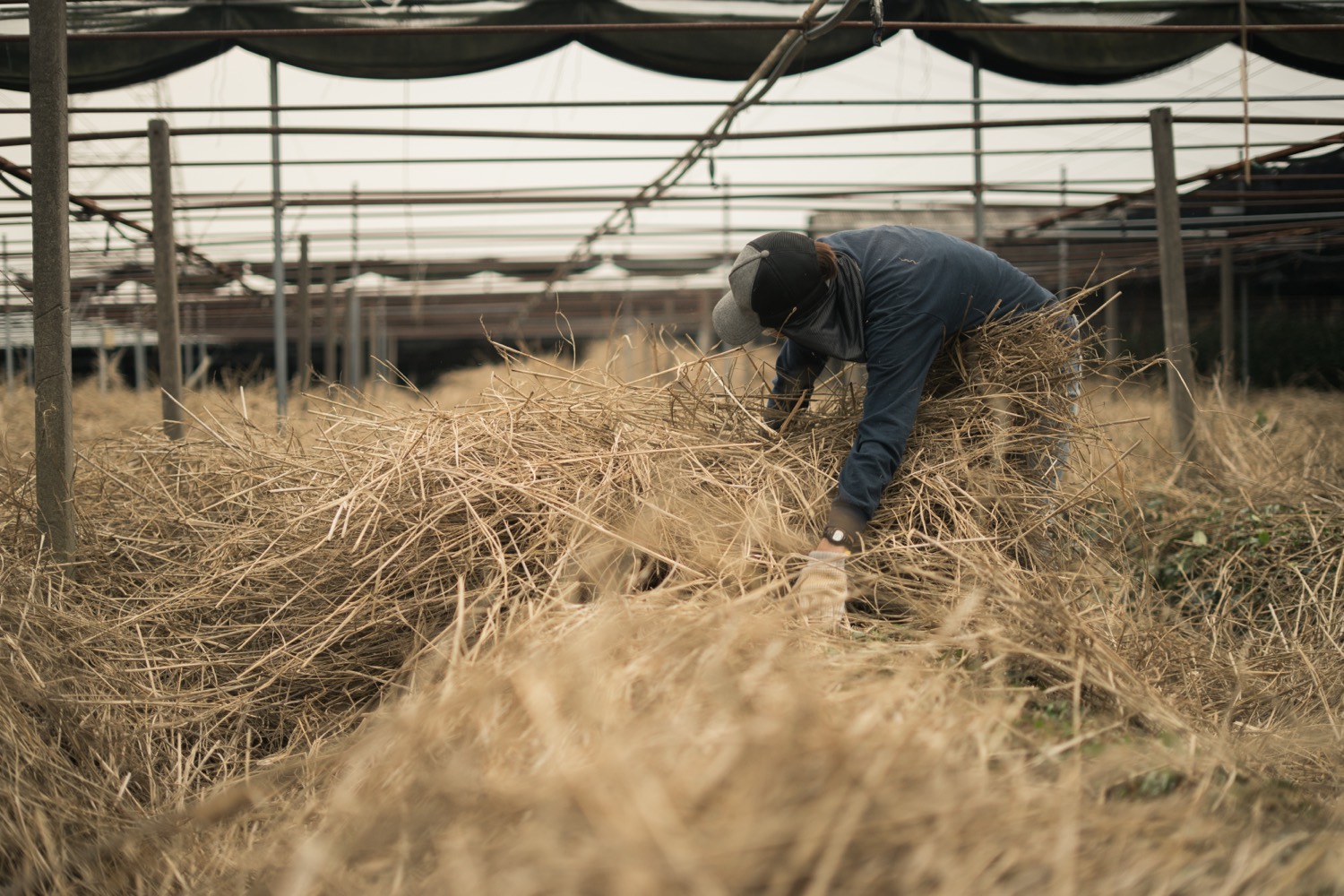
- Shading duration. Shading is the step that separates matcha from every other green tea: days under cover raise theanine and chlorophyll and suppress catechins. Forty-three days under rice straw is not the same tea as three weeks under a synthetic net, and until recently a label gave the buyer no way to tell them apart.
- Mill date. Matcha begins losing aroma from the moment it is ground. Falzon has said most matcha on American shelves is four to five months past milling; without a mill date, there is no way for a customer to know either way.
- The farmer's name. This is the one that costs something to print.
Ooika calls the last of those the dirty "direct" secret: most heritage tencha growers do not own stone mills. A Western brand that says it buys direct from the farm is, in most cases, buying matcha that somebody else ground, from a middleman who did the grinding. Naming the grower on a bag you milled yourself closes that gap. It also tells every competitor exactly whose gate to knock on.
Traceability by itself is not unique. d:matcha, in Wazuka, publishes harvest-level records — the plots picked, the dates, the processing line — through a lookup on its own website; it is also the farm, so the records are its own. Ooika's claim is narrower than that, and on the evidence of the bags it is accurate to the letter: the data is printed on the retail package, and the grower named on it is somebody else.
Two: single origin, and nothing else
Ooika was the first Matcha company world-wide that focused exclusively on single-origin Matcha with complete sourcing transparency.
Blending is the industry's default, and for a good reason. A house blend is how a brand holds a flavour steady from one year to the next, and steadiness is most of what a wholesale buyer is paying for. Single-cultivar, single-vintage matcha does the opposite. It changes, and then it runs out.
Ooika's shelf shows what that costs. At the time of writing, seven teas are in stock — six of them matcha — against roughly thirty listed as sold out, and two of the seven are down to a single bag. A café that builds a drink on one lot has to rebuild it when the lot ends.
The tencha comes from Uji, Yame, Hoshinomura, Shizuoka and Kagoshima, bought from named growers. More than 95 per cent of Japanese tea is machine-harvested; Ooika says it works in the remaining five per cent — handpicked, or shaded under reed and rice straw rather than synthetic cloth.
Three: the café that grinds everything it serves
The world's first speciality Matcha café that ground 100% of Matcha on-site.
Ooika's Lawrenceville shop opened on 27 February 2024. A month later a local writer described it as the only place in the country where a customer could watch matcha ground, prepared and served in the same room, and reported that a business braced for a dozen customers a day was getting ten times that.
The claim is a capacity problem before it is a philosophy. An ishi-usu — granite, turning slowly enough not to cook the leaf — produces about 30 grams an hour. One mill running flat out for a full day yields roughly 720 grams: about 360 servings, and only if it never rests and nothing at all is sold in bags. Ooika describes itself as the largest matcha refinery in the West, which is another way of saying that this claim is made of mills. Its standing rule is that nothing is served that was ground more than 24 hours earlier.
Others grind in public. METCHA in Seoul mills on a traditional stone grinder in the shop. Starbucks' Tokyo Roastery added stone-ground matcha in 2021. In November 2025 a Portland business, Mako Matcha Mill, announced it would mill on site and stated its own ambition to be a first for the United States — nearly two years after Lawrenceville opened. The distinction Ooika is drawing rests on the words "100%": not a mill on display, but no matcha in the building that came from anywhere else.
Four: a subscription that ships homework
The world's first single-origin, education-focused (rather than product-focused) monthly Matcha Milling Club.
The Matcha Mill Club bills itself as the world's original matcha educational subscription. There are three tiers — $40, $70 and $100 a month — and, unusually, they are priced by the value of the tea rather than its weight. A member might receive 20 grams of one month's selection and four grams of a rarer one. Each month's tea is milled and shipped inside 24 hours.
What arrives with it is the argument. Every shipment carries Ochairinikki (御茶入日記) tea notes — the farm, the cultivar, the vintage, the shading, the tasting record — and members have a private group to compare them in. Public editions dated 01/23 and 07/23 put the club in operation by the start of 2023.
Most subscription boxes are a distribution channel wearing a curriculum as decoration. This one is built the other way round: one farm, one cultivar, one vintage a month, with the paperwork that makes the difference legible. Whether it was the first of its kind is Ooika's word. That it is built that way is on the page.
Five: matcha, explained in public
First to produce deep and consistent Matcha education on Instagram Reels, that has inspired a new generation of Matcha education.
This is the weakest of the seven as a verifiable claim, and the easiest to see the effect of. Nobody keeps a register of who explained tencha shading on video first, and "inspired a new generation" is a claim about influence, which cannot be settled by anyone.
What can be looked at is the body of work. Ooika publishes a monthly matcha industry report, introductions to individual growers, national and regional competition results, and long explainers on the shortage that has run through the trade since 2024. The stated reason sits on the About page: to preserve matcha, matcha must be appreciated; to be appreciated, it must be understood.
There is a measurable second-order effect, though it belongs to the category rather than to one account. Cultivar names, shading days, tezumi, honzu, ichibancha — this was trade vocabulary a few years ago, spoken between growers, cooperatives and importers. Retail customers now ask for it by name, and the brands that cannot answer are conspicuous.
Six: a company in Japan, not a visitor
This one is not on the About page. Ooika says it is the first Western matcha company incorporated in Japan — not the first Western tea company, which is a much older category, but the first whose business is matcha and nothing else to become a Japanese entity in its own right.
It is the dullest of the seven and the one the others stand on. A foreign buyer with no Japanese company works through somebody who has one: a trading house, an exporter, an agent. A Japanese entity can hold a lease, employ people, open a bank account and contract with a grower directly. Nearly everything else in this piece — buying from named farms, the room in Kyoto that comes next — sits downstream of it.
The wording repays a second read. Western companies have incorporated in Japan to sell tea for a long time. The narrower claim is a company that does matcha and nothing else, which until recently was not a business many people thought could carry a corporate structure of its own.
Seven: a room of its own in Kyoto
Ooika Kyoto was the first guest-facing tasting room operated by a Western matcha company in Japan in our own space.
Ooika Kyoto sits in Shimogyo Ward. Read the sentence closely and it is doing careful work: not the first Western company to run tastings in Japan, and not the first to walk buyers through a farm — the first to do it in a room it holds itself, open to guests.
Western brands visit Japanese farms constantly, and harvest season in Uji and Wazuka is thick with them. Standing space is a different commitment: a lease, staff, and the obligation to be there in the months when nothing is being picked. It is the claim an outsider can least easily audit, and the one Ooika has worded most precisely.
What the label changed
Five years ago a bag of matcha could tell a buyer almost nothing, and nobody thought that strange. It can now carry a grower's name, a vintage, a count of days under shade and the date it was milled. Once one company prints those, the ones that do not have to explain why.
The seven firsts are claims about one company. The label is something else — a standard, and standards spread.
Disclosure
Matcha Wire is published by Ooika, and this article is about its publisher. Every figure here is taken from Ooika's own published pages or from third-party reporting, both listed below; nothing was accepted on the company's word where a document existed, and no quotation here was given to Matcha Wire for this piece. Corrections go to hello@ooika.co.
Sources
- Ooika, "About Us (and our Obsession) with Matcha" — ooika.co/about
- Ooika, product pages for Ujihikari (Yamazakiさん, Gokasho Uji) and Saemidori (Shimizuさん, Kageyama Uji) — ooika.co/shop
- Ooika, "Matcha Mill Club" — ooika.co/shop/p/matcha-mill-club
- Edible Jersey, "The Aroma of Shade: Matcha"
- Experience Princeton, "Business Spotlight on Ooika"
- Community News, Princeton, "What's Brewing in the Region's Cafe Scene?"
- Gary Baumgarten, "The Only Matcha Mill In The U.S. Is In Jersey", 1 April 2024
- TeaTiff, "Ooika", 14 February 2025
- d:matcha, "Harvest Traceability" — dmatcha.us/pages/traceability
- Bridgetown Bites, "Mako Matcha Mill Will Indeed Mill Matcha in Portland", 12 November 2025
- Time Out Tokyo, "Starbucks Reserve Roastery Tokyo is now serving traditional stone ground matcha", March 2021
Comments
Create a free account or sign in to join the conversation.
Be the first to comment.