
This week's reporting lines up around one tension: global matcha demand keeps climbing while Japan works to keep pace with quality, supply and definition. Matchami Lab's Omotesando pop-up (story 1) shows brands abroad stripping matcha down to a casual, everyday drink, while International Matcha Congress coverage (stories 4 and 5) shows an industry trying to agree on standards before the market outruns it.
This week in numbers
Every figure exactly as the outlet printed it, credited to the outlet that reported it and compiled by Matcha Wire.- Matcha latte varieties: 7 — reported by PR TIMES on 26 October 2026. # ↓ the story
- Tea-drink market sales change, Jan–Sept 2026: 2% — reported by 食品産業新聞社ニュースWEB on 8 November 2026. # ↓ the story
- Congress registrations from global participants: 900名超 — reported by PR TIMES on 6 November 2026. # ↓ the story
- Japanese green-tea exports, 2025: 約720億円 — reported by jacom.or.jp on 3 November 2026. # ↓ the story
Meanwhile GI registration (story 2) and shifting beverage-aisle sales (story 3) show the strain showing up at home — counterfeiting overseas and green tea losing shelf space domestically even as leaf prices climb on export demand.
01 Matchami Lab opens inaugural pop-up in Omotesando with seven flavored matcha lattes

Singapore's Matchami Lab opened its first pop-up in Omotesando with seven matcha latte flavors priced from ¥900, Nov 6–8, 2026 — reported by PR TIMES on 26 October 2026.
Matchami Lab, a Singapore-based brand, opened its first Japan pop-up in Tokyo's Omotesando from November 6 to 8, 2026, according to PR TIMES — Matcha. The shop served seven flavored matcha latte varieties starting at 900 yen, alongside baked goods made exclusively for the event. Rather than leaning on tea-ceremony imagery, the brand built its packaging and retail design around pastel, cosmetics-style visuals aimed at buyers unfamiliar with matcha etiquette. The outlet quoted the brand saying, 'While matcha is spreading worldwide, it has not quite become an everyday choice for many—the etiquette seems demanding, or the taste too bitter,' and separately, 'We want people to enjoy matcha whenever they choose, in whatever way they prefer—regardless of their nationality, their familiarity with traditional tea ceremonies, or the time of day.' The approach signals a push to make flavored matcha an everyday drink rather than a ceremonial one, aimed at buyers outside Japan's traditional tea culture.
02 Japanese Tea Enters New Era With GI Registration; Industry Foundation Strengthens

Japan's tea sector is entering what Google News — Matcha / Tea Industry describes as a new phase, after Japanese tea received geographical indication (GI) registration and the formation of a dedicated GI Promotion Committee. The move comes as counterfeit products falsely claiming Japanese origin spread overseas even as exports surge on global matcha demand. GI status functions as a government-backed quality guarantee and intellectual-property shield, treating Japanese tea as a collective trademark producers and exporters can lean on in disputes abroad. The report quotes an industry voice calling counterfeiting a situation that 'has become a serious problem overseas,' and describes GI registration as 'a powerful tool for the state to guarantee quality and protect intellectual property.' The initiative is framed as part of a broader effort to steady the production base and keep traditional know-how passing to the next generation.
The Japan Food Journal Original (Japanese) ↗ Read the full story →
03 Green Tea Beverage Sales Decline as Barley and Corn Tea Gain Share; Global Matcha Boom Drives Up Japanese Tea Leaf Prices
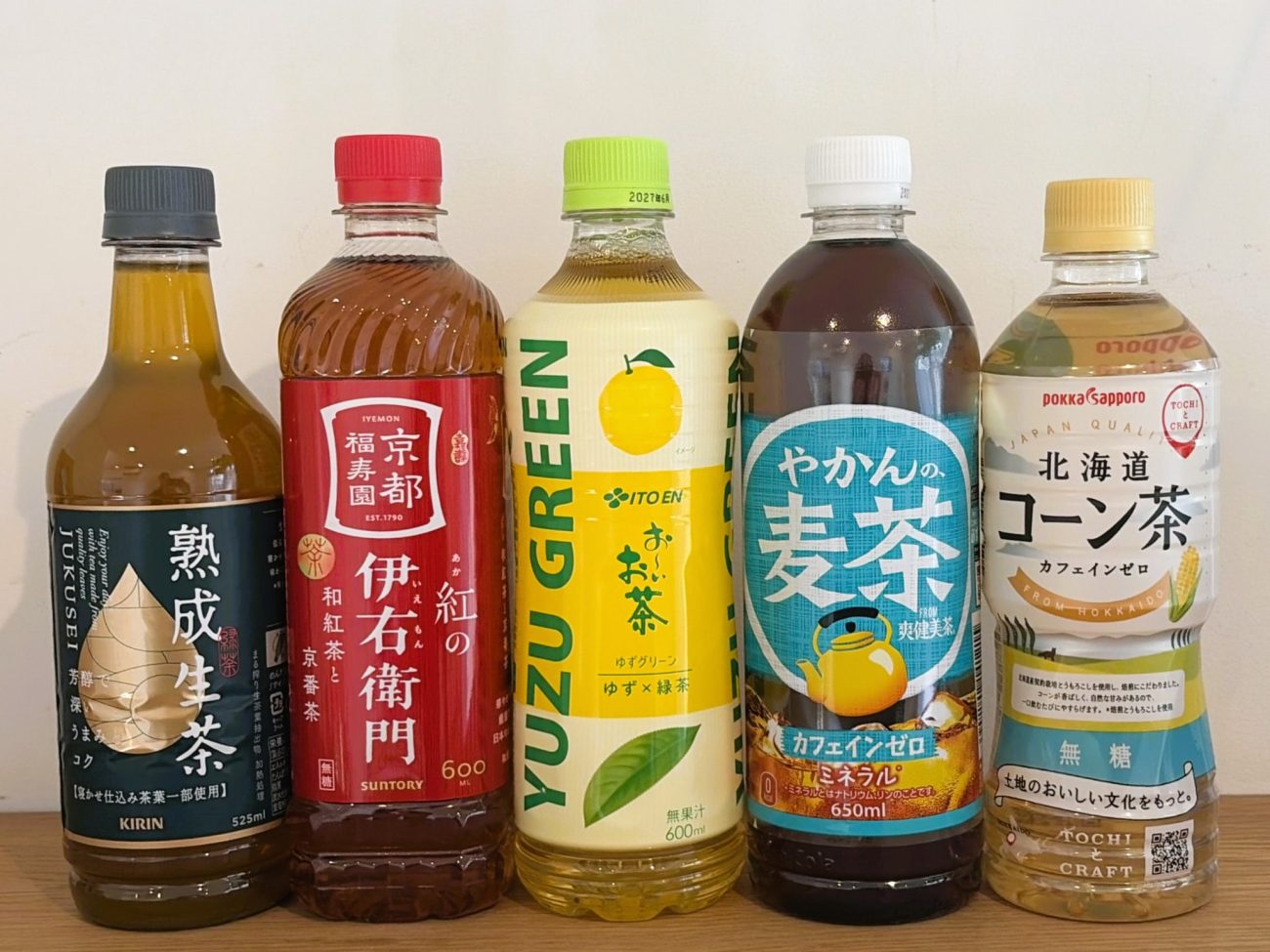
Tea-drink sales fell 2% in Jan–Sept 2026, green tea drinks dropped 5–7%, while barley tea output rose 4.4% — reported by 食品産業新聞社ニュースWEB on 8 November 2026.
Japanese tea-drink sales fell 2% in the first nine months of 2026, with green tea beverages down 5–7%, according to 食品産業新聞社ニュースWEB. The outlet ties the decline to price increases and unfavorable summer weather, while barley tea and corn tea gained ground — barley tea production rose 4.4% in 2025 against green tea's roughly flat 99.9%. Major makers including Coca-Cola, Pokka Sapporo, Suntory, Itoen and Asahi are reported to be expanding barley, corn and blended tea lines and leaning harder on flavor and aroma to compete with water for everyday drinking occasions. The same report notes overseas demand tied to the global matcha boom has pushed up domestic tea-leaf prices, squeezing green tea's economics even as it loses share at home. The result is a domestic market retreating from green tea just as the leaf itself grows costlier to buy.
04 International Matcha Congress 2026 Confirms Major Corporate Partners; Over 900 Global Registrants
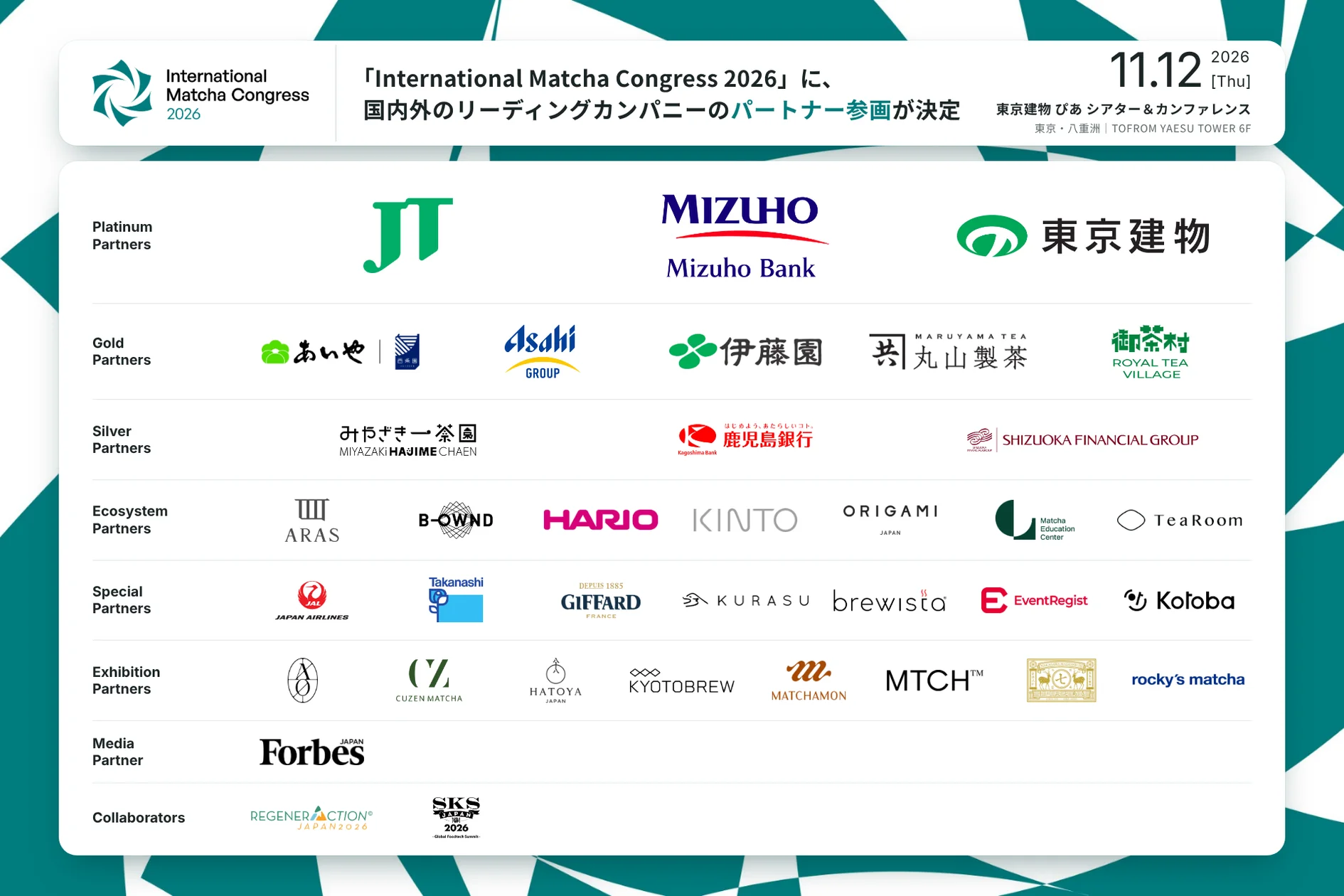
IMC 2026 drew over 900 registrants from 25 countries ahead of its Nov 12 Tokyo opening — reported by PR TIMES on 6 November 2026.
The International Matcha Congress 2026 has locked in its corporate backing and attendance numbers, PR TIMES — Matcha reports, with Platinum Partners JT, Mizuho Bank and Tokyo Tatemono joining Gold, Silver and Ecosystem partners that include Aiya, Asahi Group, Itoen and Maruyama Seicha. More than 900 participants from 25 countries have registered for the November 12 gathering in Tokyo's Yaesu district. Sessions are built around the theme 'Building the Ecosystem of Global Matcha Industry,' covering supply stability, quality-definition standards and cross-border coordination. The International Matcha Association, formed April 22, 2026, says its purpose is to settle an international matcha definition and grading system alongside education and information-sharing. One organizer is quoted saying delivering matcha's value sustainably 'requires collaboration among diverse stakeholders across production, distribution, and consumption.'
05 International Matcha Congress 2026 to Feature Former Agriculture Minister Suzuki in Opening Speech
Suzuki will open IMC 2026 as Japan's 2025 green-tea exports hit 720 hundred million yen, over triple four years earlier — reported by jacom.or.jp on 3 November 2026.
Former agriculture minister Suzuki Norikazu will deliver opening remarks at the International Matcha Congress 2026 on November 12 in Tokyo, Google News — Matcha / Tea Industry reports. His prepared statement puts Japanese green-tea exports at roughly 720 hundred million yen in 2025, more than three times the figure from four years earlier. The congress will bring together producers, companies, researchers and government officials to work toward shared international standards for matcha, including discussion of production partnerships with China and Vietnam and broader supply-chain stability. Suzuki is quoted warning that 'rapid demand expansion brings new challenges in supply systems and trust in quality' and that uncontrolled growth 'risks damaging a brand built over many years,' arguing that protecting ground-level production should go hand in hand with earning overseas.
Taken together, the week reads as an industry trying to formalize itself — through GI status, congress standards and corporate backing — at the exact moment its core product is being reinvented by casual drinkers who have never heard of a tea ceremony.
 From the Ooika shop
Seimei Matcha - Eshimaさん Yame.
$35.00
Shop now →
How this edition was made
Every weekday morning Matcha Wire scans about 40 Japanese sources — national and regional newspapers, government ministries, prefectural tea associations and trade journals — and scores each story for its relevance to the tea industry. This edition covers the five highest-ranked stories of the week just ended, one of them the week's most-read story on Matcha Wire. Figures are quoted as the outlet printed them: nothing is converted between units, nothing is converted between currencies, nothing is rescaled, averaged or estimated, and no number appears on this page that the source credited beside it did not report. Where a date here reads "reported on", it is the date the outlet published, not the date we compiled it. Matcha Wire is the compiler of these figures and never the source of one.
Compiled automatically by Matcha Wire from tracked Japanese sources, with no human editor in the loop. Every figure is credited to the outlet that reported it and checked against that outlet's own article. Corrections: hello@ooika.co.
Using these figures. The figures on this page are facts reported by the outlets credited beside them, and they are free to reuse. If Matcha Wire's compilation saved you the work, a link back is appreciated. The written analysis is ours; please don't republish it wholesale.
Matcha Wire is published by Ooika, in Kyoto, Japan. You can reach a person at hello@ooika.co.
Comments
Create a free account or sign in to join the conversation.
Be the first to comment.