
This week in numbers
Every figure exactly as the outlet printed it, credited to the outlet that reported it and compiled by Matcha Wire.- Global matcha share from China: およそ7割 — reported by ABEMA TIMES on 29 September 2026. # ↓ the story
- Planned annual production capacity: 年間100トン — reported by Yomiuri Shimbun Online on 4 October 2026. # ↓ the story
- Scheduled operations start: 2027年4月 — reported by Saga Shimbun on 3 October 2026. # ↓ the story
01 Japanese Matcha in the Global Price Competition
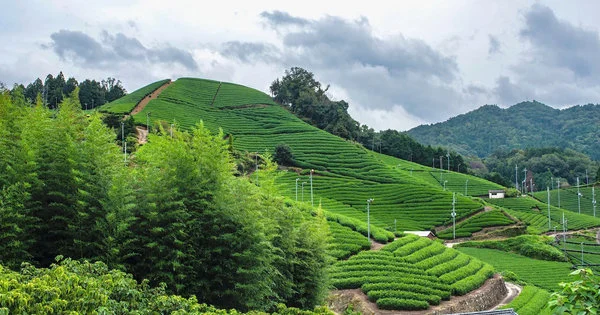
Google News reporting on Japan's tea trade shows exports of Japanese green tea reached 12,600 tonnes last year, three times the 2014 figure, while domestic matcha prices have surged alongside the overseas rush. Kagoshima prefecture overtook rivals in 2024 to become Japan's largest tea-growing region, now accounting for roughly 40% of the country's tencha supply. At the same time domestic drinking habits keep sliding: per-capita leaf consumption fell from 527 grams in 1970 to 233 grams in 2024, and tea-garden area is projected to shrink 31% between 2005 and 2025 as farmers age out. With China already producing about 70% of the world's matcha, the report argues Japan will need to compete on quality and provenance rather than scarcity, noting: 'As consumers develop a deeper understanding of matcha and learn to discern quality, the market may follow the same trajectory as the coffee market.'
02 China's matcha production surges; large-scale factories and tourism sites built in Guizhou
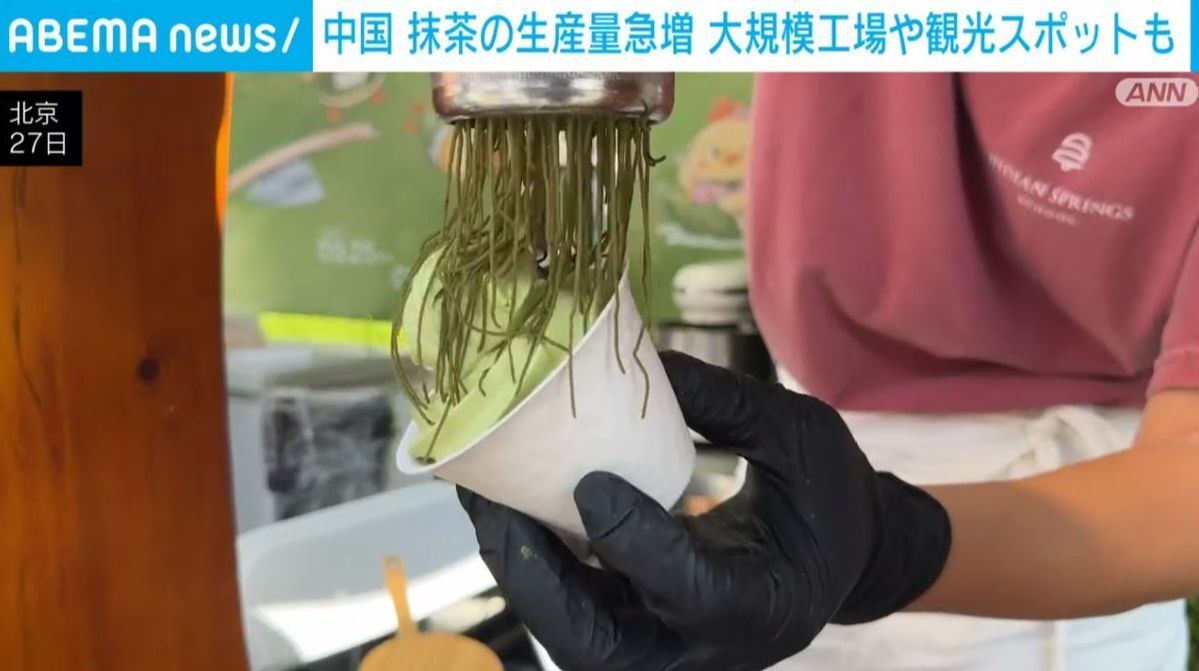
China's matcha production surged past 12,000 tonnes last year, up from under 4,000 tonnes in 2020, taking roughly 70% of global supply — reported by ABEMA TIMES on 29 September 2026.
ABEMA TIMES reports that Chinese matcha output more than tripled in four years, climbing from under 4,000 tonnes in 2020 to over 12,000 tonnes last year, giving China roughly 70% of global supply. Guizhou province's Tongren City has emerged as the fastest-growing hub, installing automated processing lines and matcha-themed tourist sites; the city alone produced 2,000 tonnes in the first half of this year, enough to make it China's top matcha region. The outlet frames this growth as a direct competitive threat to Japanese tea farmers, who now face a rival capable of matching volume and increasingly scale. As the report puts it: 'Approximately 70% of the world's matcha is said to be Chinese-produced,' adding that 'Chinese matcha has become a powerful rival for Japanese tea farmers.'
03 Tea prices in 2026 jump to 1.8 times 2025 levels; Shizuoka pursues new measures to protect the region's tea industry
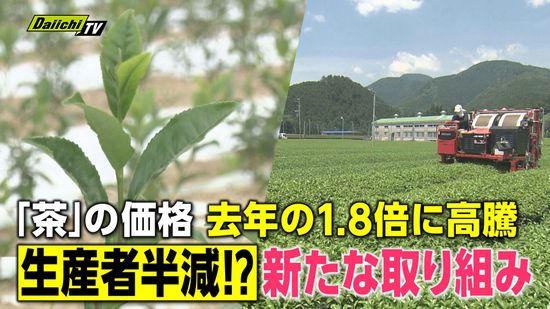
Shizuoka's tea market saw trading prices jump to 1.8 times the 2025 level in 2026, covering both first and second flush, according to Google News coverage of the region's price and export pressures. The gain has lifted morale after years of decline, though producers say rising costs for packaging, fuel and fertilizer eat into the increase. The number of growers in the prefecture has nearly halved over five years, a trend blamed on aging farmers and terraced land too steep to mechanize. In response, the regional government is consolidating roughly 300 hectares of farmland by fiscal 2027, drawing in 94 original landowners, to allow container-style cultivation; some growers are also installing solar canopies to automate tencha shading. One grower quoted in the report warns that without strong branding, 'China will certainly outprice us.'
04 Ohashi Seicha expands matcha processing plant in Kagoshima; production to reach 100 tons annually by 2028

Planned annual production capacity: 年間100トン — reported by Yomiuri Shimbun Online on 4 October 2026.
Ohashi Seicha will expand its Kagoshima processing plant to produce 100 tons of matcha a year by March 2028, five times current capacity, the Yomiuri Shimbun reports. The 1.6 billion yen project, covering a new 1,818-square-meter facility, follows a location agreement signed with the city on November 2, with construction starting this month. The company says consolidating processing within the prefecture will prevent repeats of a previous outsourcing arrangement that once halted operations for three months, and will let it respond more reliably to both domestic and export demand. A company representative is quoted saying the move aims to 'sell matcha stably and protect Kagoshima's tea farmers,' and expects the prefecture's reputation for quality tea to spread further at home and abroad.
05 Ureshino Tencha Processing Plant Under Construction; Operations Targeted for April 2027

Scheduled operations start: 2027年4月 — reported by Saga Shimbun on 3 October 2026.
Ureshino, in Saga Prefecture, broke ground on September 26 on the prefecture's first dedicated tencha processing plant, with operations scheduled to start in April 2027, the Saga Shimbun reports. Saga has never had its own tencha mill, instead sending leaf to neighboring Nagasaki Prefecture for processing, a workaround that added delay and cost as global matcha demand grew. The new facility at the Fudomiyama site in Ureshino-cho is meant to close that gap and let producers process locally rather than ship leaf across prefectural lines. The paper quotes a line summing up the rationale: 'Tencha demand has grown with the global matcha boom, but Saga Prefecture had no processing facility and relied on mills in Nagasaki Prefecture.'
Taken together, the five reports describe an industry pouring money into land and machinery just as its biggest rival scales up faster still, leaving Japan's producers to bet on quality and brand rather than volume.
 From the Ooika shop
Ooika Matcha Storage Jar
$10.00
Shop now →
From the Ooika shop
Ooika Matcha Storage Jar
$10.00
Shop now →
How this edition was made
Every weekday morning Matcha Wire scans about 40 Japanese sources — national and regional newspapers, government ministries, prefectural tea associations and trade journals — and scores each story for its relevance to the tea industry. This edition covers the five highest-ranked stories of the week just ended, one of them the week's most-read story on Matcha Wire. Figures are quoted as the outlet printed them: nothing is converted between units, nothing is converted between currencies, nothing is rescaled, averaged or estimated, and no number appears on this page that the source credited beside it did not report. Where a date here reads "reported on", it is the date the outlet published, not the date we compiled it. Matcha Wire is the compiler of these figures and never the source of one.
Compiled automatically by Matcha Wire from tracked Japanese sources, with no human editor in the loop. Every figure is credited to the outlet that reported it and checked against that outlet's own article. Corrections: hello@ooika.co.
Using these figures. The figures on this page are facts reported by the outlets credited beside them, and they are free to reuse. If Matcha Wire's compilation saved you the work, a link back is appreciated. The written analysis is ours; please don't republish it wholesale.
Matcha Wire is published by Ooika, in Kyoto, Japan. You can reach a person at hello@ooika.co.
Comments
Create a free account or sign in to join the conversation.
Be the first to comment.